Journal/Planning
How to Plan a Wedding Weekend Without Wearing Out Guests
Nearly one in three weddings now spans three days or more, according to The Knot. This is how to set the schedule, who to invite to each event, and which event to drop first when budget runs short.
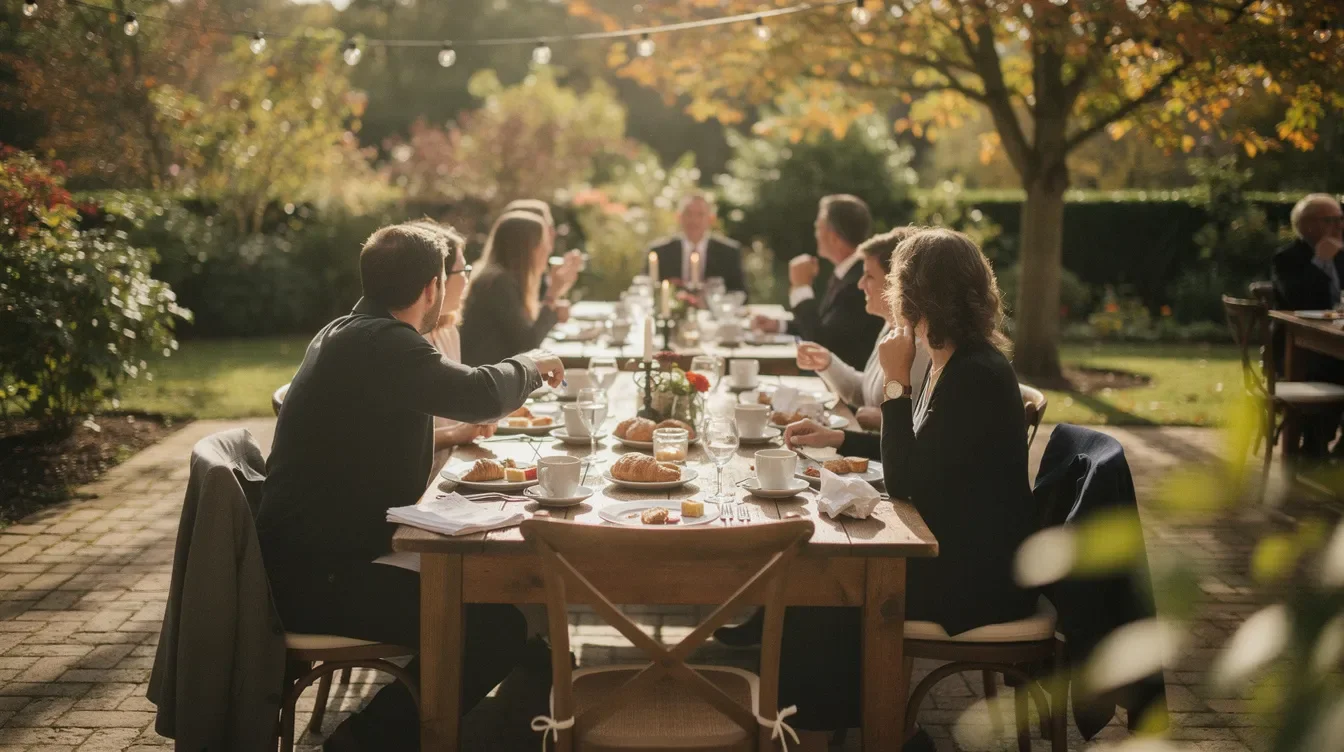
A wedding weekend itinerary works best with one hosted event per day, a clear note on which events are open to every guest, and long stretches with nothing scheduled. French’s Point, a wedding venue in Stockton Springs, Maine, suggests leaving about 40 to 50 percent of each day unplanned. If you add only one event to the wedding itself, make it a casual welcome party the night before, open to everyone.
Multi-day weddings are no longer unusual. The Knot’s 2027 trends report, built on search, save and spend data from 1.7 million U.S. couples, says nearly one in three weddings already spans three days or more. Zola’s 2026 First Look Report, as summarised by Stacker, put the share of engaged couples planning two- or three-day celebrations at 18 percent. The two figures measure different things (platform behaviour versus stated plans), so treat the trend as real and its exact size as uncertain.
What a three-day schedule usually looks like
The common shape is welcome event, wedding, send-off. The Knot describes couples treating the welcome dinner and the day-after brunch as separate events with their own design and photography, and notes that DJs may now be booked for a welcome party or a morning-after brunch.
A workable version:
- Day one, evening: a welcome party of two to three hours, with food, open to every wedding guest.
- Day two: the wedding. Nothing scheduled for guests before the ceremony except one optional morning activity.
- Day three, late morning: a farewell brunch with a wide arrival window.
That is three hosted events. Anything beyond them is optional and should be labelled that way on the schedule.
Who gets invited to what
The rehearsal dinner and the welcome party have different guest lists. Junebug Weddings describes the rehearsal dinner as usually limited to close family and the people in the ceremony, while the welcome party is generally open to everyone invited to the wedding. The etiquette guide on Historic Oakland’s blog makes the same call for the morning-after brunch: invite the full guest list and expect that not all of them will come.
If your rehearsal dinner is small, a welcome party solves an awkward gap. Guests who travelled in the day before are otherwise left at the hotel bar while a smaller group eats somewhere else. Rock My Wedding suggests a bonfire, a cocktail hour or a game night for guests who are not at the rehearsal dinner. That can be as simple as booking the hotel terrace for two hours after the rehearsal.
Put the open-to-all events on the wedding website and in the invitation suite. Send invitation-only events on a separate card or in a direct message, so nobody reads the website and assumes they are invited.
How much free time to leave
This is where weekend schedules usually go wrong. Junebug warns against an itinerary so full that nobody has time to rest, and French’s Point notes that families with children will want breaks and naps in particular.
A simple rule: one hosted event per day, plus at most one optional activity. If you add a group hike on the morning of the wedding, it is optional, it ends by noon, and nobody who skips it misses anything. For the gaps, Junebug suggests giving guests a short local guide with places to eat and things to do on their own. A one-page list on the wedding website covers it.
Tell guests plainly that they are not expected at every event. Junebug recommends saying this outright and being understanding when work or budget keeps people away. A three-day wedding means extra hotel nights, extra outfits and extra days off work for your guests. If someone can only make Saturday, that should feel normal to them and to you.
The welcome party
Keep it casual and feed people. Junebug suggests serving at least appetizers and holding the party the evening before the wedding, or two days before if you want a longer celebration. Alcohol isn’t required. If you aren’t covering drinks, say so on the invitation or website in advance. A couple of complimentary drinks per guest followed by a cash bar is one middle option Junebug mentions.
You don’t need to stay until the end. Joan Nilsen, a wedding planner with Ambiente, told Mpls.St.Paul Magazine that some of her couples come to the welcome party for half an hour or an hour and then leave, and that this is fine. The night before your wedding is a reasonable night to go to bed early.
The after-party
Plan it in advance or skip it. Justin Roff, a DJ with Instant Request, told the same magazine that an after-party pulled together at the end of the night often fails to get going. If you want one, book the room, the music and some late-night food ahead of time, and tell guests where it is. If you don’t plan it, assume it won’t happen, and accept that as a fine outcome.
The farewell brunch
Give it a long window. Nilsen recommends a two-hour timeframe so guests with early flights and guests who slept in can both come. Brunch is also an easy event to drop if budget or energy runs short. Amy Zaroff, a wedding planner quoted in the same piece, said guests are there to celebrate the marriage and “everything else is icing on the cake.”
Who pays for the extra events
Settle this before you send save-the-dates. Zaroff notes that when the bride’s parents are paying for the wedding, they often cover the brunch as well. Junebug suggests the welcome party can be paid for by the couple, shared with parents, or covered by the side of the family that isn’t funding the wedding. Prices are moving in the wrong direction: Bank of America Institute data cited by Axios in October 2026 shows average U.S. spending on wedding vendors up 8.5 percent through May compared with a year earlier.
When to tell guests
A weekend needs more lead time than a single-day wedding. Junebug recommends save-the-dates eight to twelve months ahead, especially for multi-day or travel weddings. French’s Point suggests sending save-the-dates once you have a rough itinerary, invitations about 120 days out, and a six-week reply window. Put the full schedule on the wedding website before invitations go out, with start and end times, dress expectations and which events are open to everyone, so guests can book the right number of hotel nights.
Junebug also points to a venue with lodging, or a hotel room block plus transport between events, as the way to keep the weekend from becoming a logistics problem for guests. And hand at least one event to someone else: French’s Point suggests giving secondary events to a planner or a family member so you can spend the weekend with your guests.
Questions couples ask
Who should be invited to a wedding welcome party?
Generally everyone invited to the wedding. The rehearsal dinner is the smaller event, usually limited to close family and the people in the ceremony.
How much free time should a wedding weekend leave?
French's Point, a wedding venue in Maine, suggests leaving about 40 to 50 percent of each day unscheduled. One hosted event per day plus at most one optional activity is a simple rule.
How long should a farewell brunch last?
Wedding planner Joan Nilsen recommends a two-hour window so guests with early flights and guests who slept in can both come.
When should you send save-the-dates for a wedding weekend?
Junebug Weddings recommends eight to twelve months ahead for multi-day or travel weddings.